
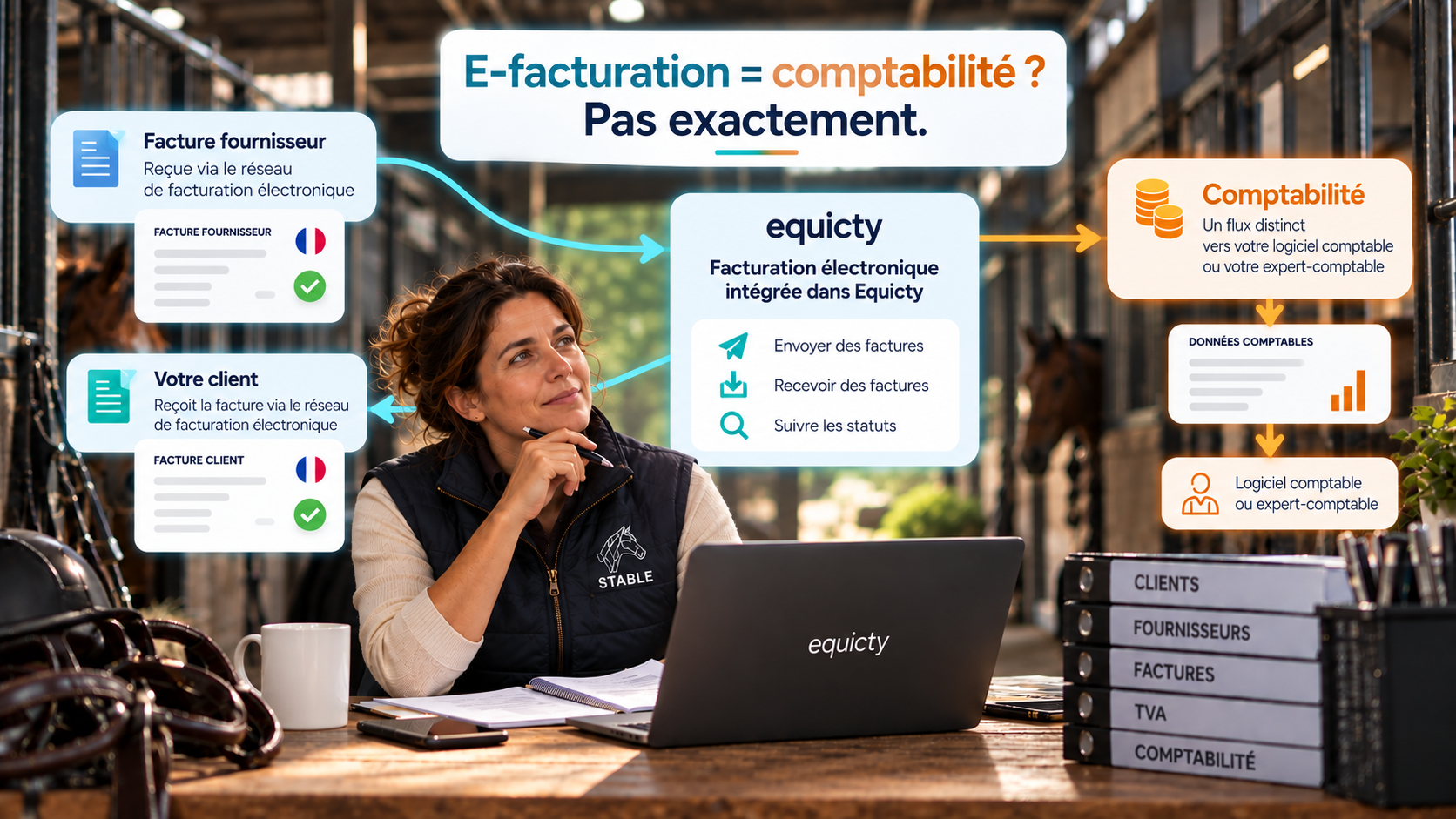
“From September 2026, I’ll be receiving my invoices electronically. So they’ll reach my accountant automatically, right?”
Not necessarily.
This is one of the most common mix-ups we see today among stables, riding centres, breeders and other equine businesses. It’s also perfectly understandable: the words “e-invoicing” suggest that everything becomes digital from end to end, all the way into the accounts.
In reality, two different processes are at work. Confusing them means risking preparing for one while forgetting the other. The good news: once the distinction is clear, everything becomes much easier to organise.
This article is about the French e-invoicing reform specifically, and about what it does and does not change for your accounting.
E-invoicing ≠ accounting: the key idea
E-invoicing determines how an invoice is issued, transmitted, received and tracked between two businesses, through the regulated circuit created by the reform.
Accounting determines what happens next: how the invoice and its data are recorded, allocated, matched with payments, taken into account for VAT, and then used by the business or by its accountant (expert-comptable).
A business can therefore receive a perfectly compliant electronic invoice… without that invoice having been booked in the accounts.
A concrete example. Your forage supplier, your farrier or your vet issues you an invoice. It reaches you through the e-invoicing circuit: e-invoicing has done its job. But the invoice isn’t in your accountant’s software just because of that. To get there, it needs a second step of a different kind: the accounting transfer.
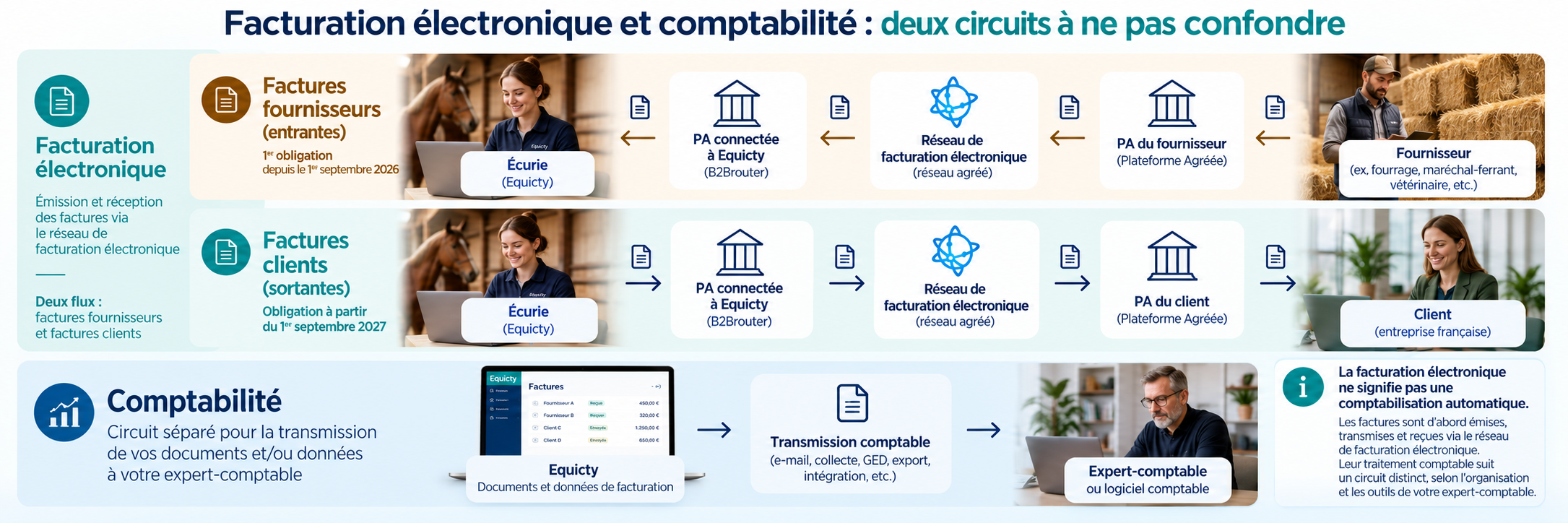
Tap or click the visual to open it full size. The visual is in French and illustrates the French e-invoicing system.
This diagram sums up the essentials: two e-invoicing flows (the supplier invoices you receive, the customer invoices you send) and, separately, an accounting flow that carries your documents and data to your accounting software or your accountant.
How does an electronic invoice actually travel?
Let’s start with the invoices you receive, because receiving is the first major obligation of the reform: since 1 September 2026, all businesses concerned by the reform must be able to receive electronic invoices. Issuing is being phased in: since 1 September 2026, large companies and mid-sized companies (ETIs) must also issue electronic invoices; from 1 September 2027, it will be the turn of SMEs and micro-enterprises.
A supplier invoice arriving at your business
When a supplier issues you an electronic invoice, it isn’t sent to you like an ordinary e-mail. It travels like this:
Supplier → supplier’s approved platform → e-invoicing network → approved platform connected to Equicty → Equicty / your stable.
Approved Platforms (Plateformes Agréées, PA) are operators registered by the French tax authority. Among other things, they handle the issuing, transmission and receipt of electronic invoices under the reform.
The Annuaire de la facturation électronique (the e-invoicing directory) makes it possible to identify a business’s electronic address and the platform that handles receipt of its invoices.
A customer invoice you issue
In the other direction, the path is the same, reversed:
Stable / Equicty → approved platform connected to Equicty → e-invoicing network → customer’s approved platform → customer.
For SMEs and micro-enterprises, issuing electronic invoices becomes mandatory from 1 September 2027; receiving them has already been required since 1 September 2026, which is why it makes sense to start with supplier invoices.
For you, day to day, nothing complicated: you work from Equicty. The regulated transmission is handled in the background by the appropriate infrastructure. Equicty is integrated with B2Brouter, which is the Approved Platform (PA) providing this connection. Equicty is not itself an Approved Platform, and you don’t need to create a separate B2Brouter account.
You’ll find the big picture, with the key dates, in our practical guide to the 2026–2027 reform.
An electronic invoice is not simply a PDF
A second very common misconception: “an e-invoice is a PDF sent by e-mail”.
The PDF is still useful. It’s a document a person can read, handy for viewing, archiving or attaching to a file. But sending a PDF by ordinary e-mail is not, by itself, an electronic invoice within the meaning of the French reform, nor the regulated circuit that goes with it.
What makes the difference isn’t the document itself, but everything around it:
- structured, compliant invoice data that a system can read automatically;
- transmission through the network, via the approved platforms;
- identification of the sender and the recipient (SIREN, VAT…);
- life-cycle tracking of the invoice, with statuses;
- end-to-end traceability.
In other words: the PDF is a representation of the invoice. E-invoicing is the structured transmission and tracking around it.
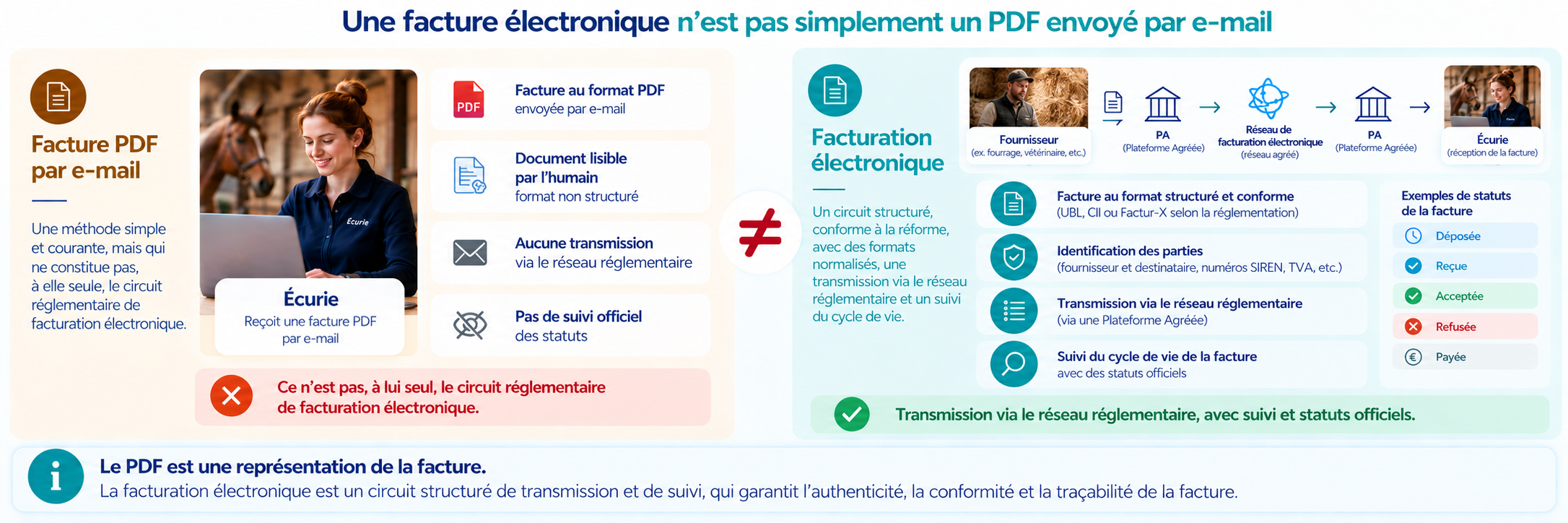
Tap or click the visual to open it full size. The visual is in French and illustrates the French e-invoicing system.
Sent, received, accepted, refused, paid: not the same thing
Once the invoice is in the circuit, several pieces of status information can coexist. They answer different questions, and it’s best not to mix them up.
1 · TRANSMISSION
Has the invoice actually entered the circuit?
This is the first level: has the invoice been submitted, transmitted, and then received by the recipient?
2 · INVOICE STATUS
What happened next?
Depending on the situation, the invoice can for example be marked as submitted, received, accepted or refused by its recipient.
3 · PAYMENT AND ACCOUNTING
Has the invoice been paid, and then processed in the accounts?
Payment and accounting entries are separate pieces of information: they concern money and bookkeeping entries, not the circulation of the document.
The takeaway fits in three sentences:
“Received” doesn’t necessarily mean “accepted”.
“Accepted” doesn’t mean “paid”.
“Paid” doesn’t mean “booked in the accounts”.
Not all statuses apply in the same way to every situation, and the detail depends on the type of transaction. What matters is knowing that they exist and that they say different things. In Equicty, the e-invoice information and its useful statuses can be followed directly from the invoicing workflow, alongside the payment status.
And how does the invoice then reach my accounting?
Back to the original question. Receiving an invoice electronically doesn’t mean it has automatically been booked by your accountant. The e-invoicing circuit ends once the invoice has been delivered. What happens afterwards is a separate job: the accounting transfer.
There isn’t just one way of doing it. It depends on how your accountant’s firm is organised and the tools it uses. Depending on the tools your firm uses — for example ISAGRI, Agiris/ISACOMPTA, EBP, Sage or other solutions — the transfer method may differ. These names are only examples of accounting environments: they don’t mean that Equicty currently has a direct integration with any of them.

Tap or click the visual to open it full size. The visual is in French and illustrates the French e-invoicing system.
Here are the five main possibilities you come across in practice.
1. E-mail or dedicated address
A PDF, a photo or a scan is sent to a dedicated e-mail address used by the firm or its software, or entrusted to a document-collection service. Some tools then apply document recognition (OCR) or another processing service after receipt. Depending on the case, the process is manual or semi-automatic.
2. Document portal, GED or shared space
Invoices are uploaded to a document portal, a document-management system (GED), a cloud folder or a shared accounting space. The firm or its software then retrieves the documents from that space to process them.
3. Accounting export
Accounting information (entries, invoice data…) is exported, for example as CSV or Excel or in another compatible format, and then imported into the accounting software: this is a file exchange. The possible formats vary a lot from one software to another: it’s best to ask your accountant’s firm.
4. Direct integration, API or connector
When both tools allow it, invoices and/or accounting data can flow through a direct integration, an API or a connector. This can reduce manual handling, but it depends entirely on the systems involved: this option isn’t available everywhere.
5. Manual processing
The invoice, often as a PDF, is sent to the accountant, who enters or processes it manually. This remains a perfectly valid way of working, including in an e-invoicing environment.
So what does e-invoicing do, and what does accounting do?
To fix ideas, here is the simplest possible summary.
E-INVOICING
Moving the invoice between businesses
In line with the new electronic framework. For example:
- issuing and receiving;
- the network and the approved platforms (PA);
- identification of the businesses;
- statuses;
- traceability.
ACCOUNTING
Turning invoices into accounting information
From invoices and their data, usable accounting entries are produced. For example:
- booking and allocation;
- matching with payments;
- VAT;
- export or import;
- transfer to the accountant and their software.
The two processes can be linked technically. But they are not the same thing.
And with Equicty?
Equicty’s aim is to keep everyday invoicing simple for equestrian professionals. For a French business using Equicty’s Finance features:
e-invoicing is activated directly inside Equicty;
B2Brouter, an Approved Platform (PA), provides the connection to the network, with no separate B2Brouter account to create;
electronic supplier invoices can be received in Equicty;
electronic invoices can be sent from Equicty;
useful statuses can be followed in the invoicing workflow;
e-invoicing is included in the Finance module, without a separate e-invoicing subscription.
It is worth keeping the two topics apart, though: e-invoicing in Equicty does not, on its own, mean automatic integration with your accountant’s software. On the accounting side, the right set-up depends on your accountant and their tools. Depending on the case, it may involve sending documents, exports and imports, or, when both systems allow it, integrations or connectors. This article does not announce any specific accounting integration or timeline.
To see how all of this works in practice, visit our dedicated page on e-invoicing in France.
The right question to ask your accountant
You may already be asking your accountant: “are you ready for e-invoicing?”. That’s useful, but one question is missing:
“How would you like to receive my invoices and my accounting data once they have been issued or received electronically?”
To get a more precise answer, you can ask:
Do you use a dedicated e-mail address for accounting?
Do you prefer a portal or a GED?
Would you rather have an accounting export?
Is there a specific file format to follow?
Is there a connector or an API with your software?
Or does the processing stay manual?
In summary
E-invoicing changes the regulated path of the invoice. Accounting remains the process that turns those invoices into accounting information. The two can be linked, but they are not the same process.
For an Equicty customer, the goal should stay simple: manage the invoicing flow day to day from Equicty, and organise the handover to accounting according to the tools and working method of their accountant.
This article is educational: it is neither legal advice nor accounting advice, and it does not replace the advice of your accountant.
Go further
Understand e-invoicing in France →
ACTIVATE E-INVOICING
Set up your French business and activate e-invoicing. (Guide in French.)
SEND AN E-INVOICE
Create, send and track an electronic invoice from Equicty. (Guide in French.)
RECEIVE AN E-INVOICE
View, accept and process the electronic invoices you receive. (Guide in French.)
E-INVOICING FAQ
Answers to the most frequent questions about the French reform and Equicty. (In French.)