
EUROPEAN ELECTRONIC INVOICING
Manage your stable, services, finance and electronic invoices from one connected environment.
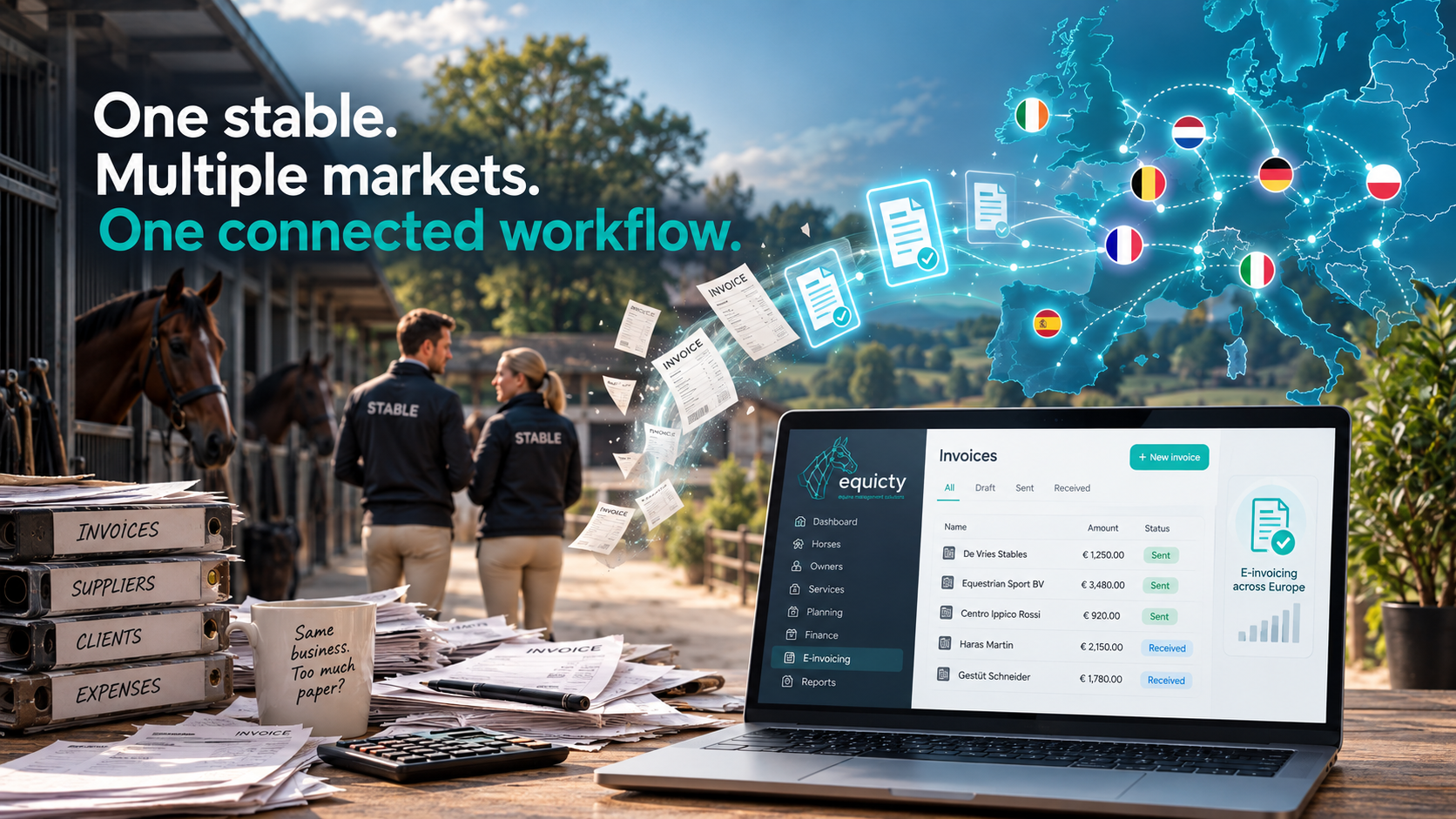
FROM PAPER TO ELECTRONIC INVOICING
Professional stables often manage horses, owners, services and invoices across multiple tools, spreadsheets, documents and accounting workflows.
Electronic invoicing isn't simply about replacing a paper invoice with a digital document. The bigger opportunity is connecting the operational activity that creates the invoice with the financial workflow that sends it.
The horse, the owner and the service already exist in Equicty. The invoice should be the next connected step — not a separate system to manage on the side.
EUROPEAN CONTEXT
Across Europe, invoicing is steadily moving from paper and PDF documents toward structured, machine-readable electronic formats. The direction is consistent — but the pace and the details are not.
Implementation differs from country to country. National mandates don't share a single timetable, and the technical infrastructure behind them isn't identical either: some countries route invoices through the Peppol network, others operate their own dedicated platforms.
At EU level, this shift is reinforced by the VAT in the Digital Age (ViDA) reform, adopted in 2025 and rolling out progressively. From 1 July 2030, Digital Reporting Requirements will require structured electronic invoicing and near-real-time reporting for cross-border B2B transactions between EU businesses. Many countries — including Belgium and France — have already introduced their own domestic e-invoicing obligations well before that date, under rules ViDA allows Member States to set independently.
<p class="feature-para">In practice, this means “electronic invoicing” increasingly refers to invoice data encoded so systems can exchange and process it automatically — not simply a PDF sent by email.</p>
2025
ViDA adopted
The EU's VAT in the Digital Age reform enters into force.
2026–2027
Domestic mandates
Countries including Belgium and France introduce their own B2B e-invoicing obligations.
2030
Cross-border reporting
EU-wide digital reporting applies to cross-border B2B transactions from 1 July.
STRUCTURED VS PDF
A PDF attached to an email may be digital, but it's primarily a visual document made for a person to read. A structured electronic invoice contains the same information in a standardized, machine-readable format, so compatible systems can exchange and process it electronically — without someone retyping it on the other end.
TRADITIONAL DIGITAL INVOICE
Service ↓
Invoice ↓
PDF ↓
Email ↓
Customer receives document ↓
Information may still require manual processing
STRUCTURED ELECTRONIC INVOICE
Service ↓
Invoice data ↓
Structured electronic format ↓
Electronic exchange ↓
Receiving system ↓
Data can be processed digitally
ONE STABLE. MULTIPLE MARKETS.
European electronic invoicing isn't one identical system copied across every country. Requirements can differ in timing, scope, reporting obligations and the exchange infrastructure each country uses.
In Belgium, Peppol plays a central role in the exchange of structured B2B electronic invoices. In France, electronic invoicing relies on approved platforms operating within the framework defined by the French administration. Other countries will set their own rules as their own mandates take shape. The differences are real — but your stable's workflow shouldn't have to change every time a new market introduces its own requirements.
Equicty already supports dedicated electronic invoicing workflows for Belgium and France, with an architecture designed to expand as electronic invoicing requirements evolve across Europe.
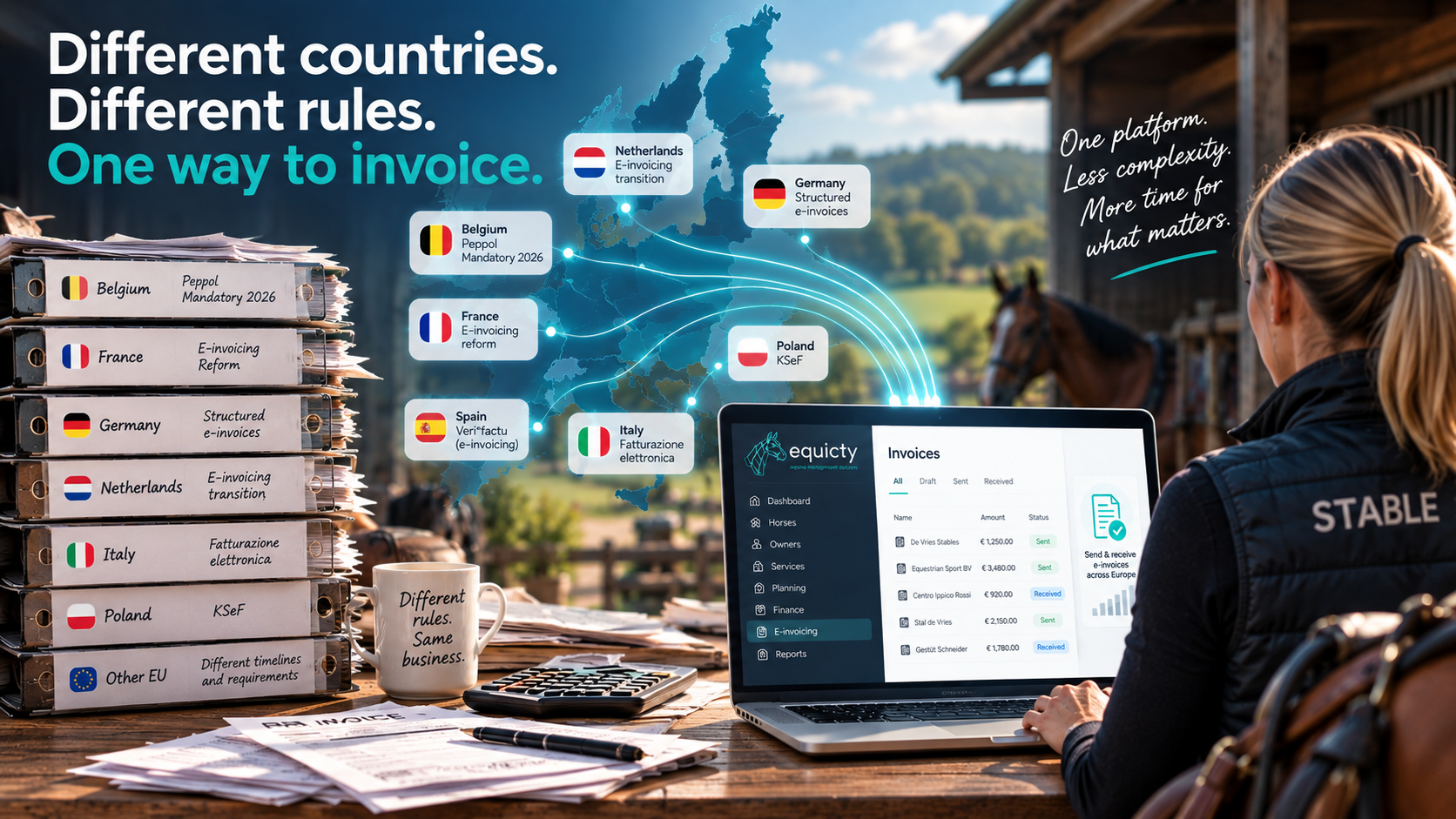
INTERNATIONAL EQUESTRIAN BUSINESS
A Belgian sport stable may train a horse owned by a French company, buy services from a supplier in the Netherlands, sell a horse to Germany and compete across several countries in a single season. International breeders work with owners, vets, transporters and stallion stations spread across borders. Equestrian centres often serve private clients and professional businesses side by side.
The invoice starts with a real equestrian activity — but the applicable invoicing and reporting requirements can depend on the customer, the transaction and the market involved.
SCENARIO 1
International owner
A professional stable manages and trains a horse belonging to an owner or company based in another European country.
SCENARIO 2
Cross-border supplier
The stable receives professional services or products from a supplier established in another market.
SCENARIO 3
Horse sale
A professional equestrian business sells a horse to a buyer across borders.
SCENARIO 4
Competition & services
Training, transport or competition-related services involve parties based in different countries.
Depending on the transaction and the parties involved, different invoicing and reporting requirements may apply.
HOW EQUICTY WORKS
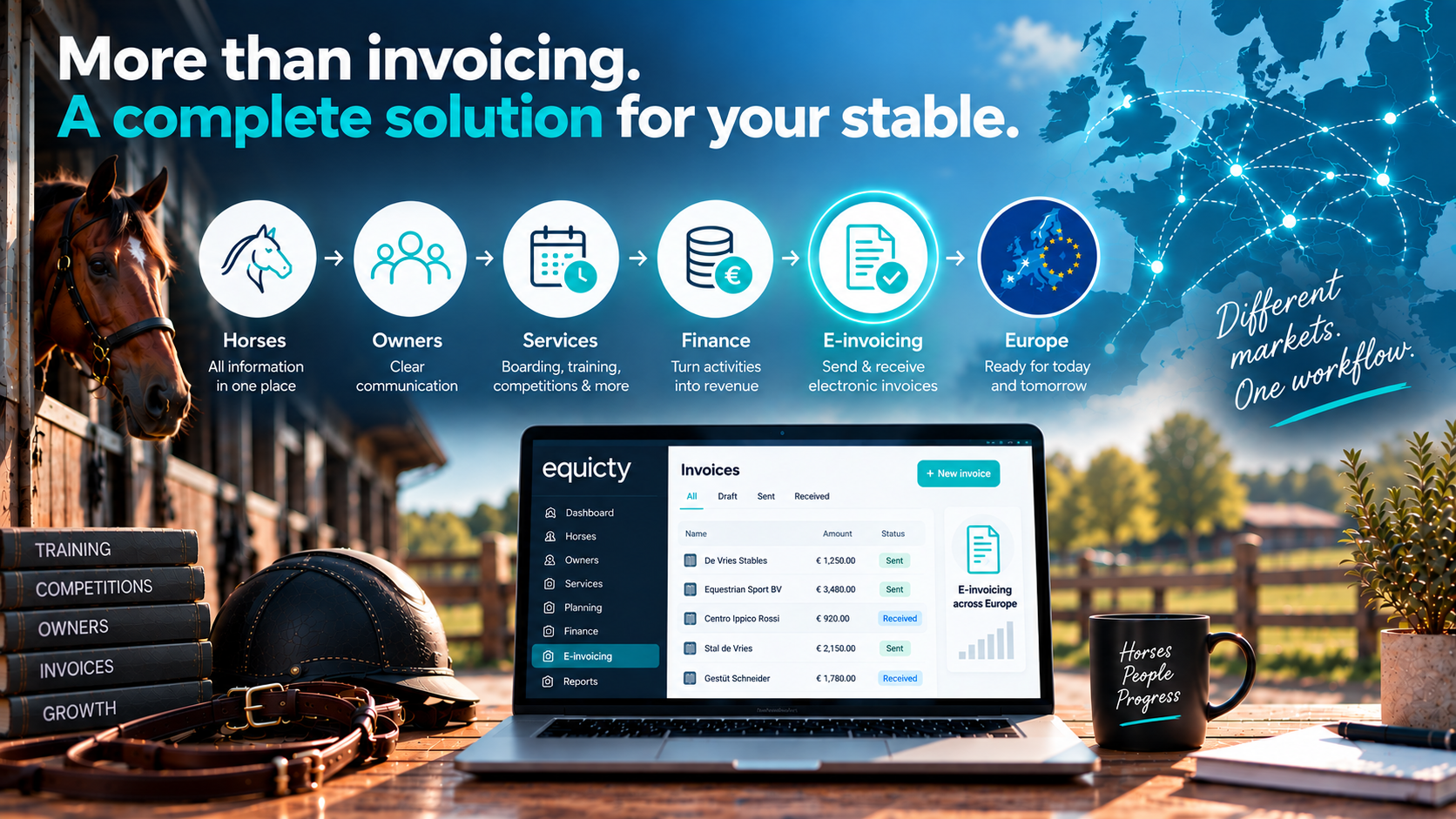
Most standalone invoicing software starts when you create the invoice. Equicty starts with the activity that creates it.
01
Horse
The workflow starts with the horse already managed in Equicty.
02
Owner / client
Connect the horse and its services to the right owner or customer.
03
Service
Boarding, training, competition services, transport and other billable activities create the commercial information.
04
Finance
That information becomes part of the connected invoicing workflow.
05
Invoice
Prepare the invoice inside the same connected environment.
06
E-invoicing
Use the supported electronic invoicing workflow for the applicable market.
SEND & RECEIVE
Preparing for electronic invoicing isn't only about sending sales invoices. Businesses increasingly also need a structured way to receive and process incoming electronic invoices.
SEND
Create invoices from the services and activities already recorded in Equicty, and use the supported electronic invoicing workflow to send structured invoice data for your market.
RECEIVE
Electronic invoicing also changes the receiving side. Where supported, supplier invoices can enter a digital financial workflow instead of staying scattered across email inboxes, PDFs and manual administration.
CONNECTED TO THE STABLE
Most invoicing tools see a customer and an invoice. Equicty sees the broader operational context behind it: horse, owner, services, operations, finance, invoice, electronic invoice.
Boarding
Training
Competition services
Additional stable services
Professional services
Horse-related charges
These activities flow into finance and invoicing without building a separate administrative system alongside your stable management.
Your stable creates the activity. Equicty connects it to the administration.
GOOD TO KNOW
PEPPOL
The exchange framework
Peppol is an interoperability framework and network for exchanging standardized electronic business documents through accredited service providers. It plays an important role in electronic invoicing in several European markets — including Belgium — but it isn't a single EU-mandated standard, and its role differs from country to country.
EN 16931
The European semantic standard
EN 16931 defines a common semantic data model for the core elements of an electronic invoice, so systems built by different vendors can understand the same information. An updated version, EN 16931-1:2026, was published to support the requirements of the EU's ViDA reform.
VIDA
The EU's VAT digitalisation framework
VAT in the Digital Age (ViDA) is the EU reform modernising VAT reporting and expanding the role of structured electronic invoicing. From 1 July 2030, Digital Reporting Requirements apply to cross-border B2B transactions between EU businesses. Several countries, including Belgium and France, have introduced their own domestic e-invoicing obligations independently and ahead of that date.
COUNTRY-SPECIFIC E-INVOICING
European direction is becoming increasingly digital, but implementation remains country-specific. Choose the market relevant to your business.
🇧🇪
BELGIUM
Peppol E-Invoicing
Structured B2B electronic invoicing has been mandatory for nearly all transactions between Belgian VAT-liable businesses since 1 January 2026, generally via the Peppol network, subject to the applicable legal scope and exceptions. Equicty provides a dedicated Belgian workflow built around this requirement.
Explore e-invoicing in Belgium →🇫🇷
FRANCE
French Electronic Invoicing
France is phasing in its own electronic invoicing reform: all businesses must be able to receive e-invoices from September 2026, with sending obligations phasing in by company size. Equicty provides a dedicated country-specific solution for French stables.
Explore e-invoicing in France →Is electronic invoicing mandatory across Europe?
Not in one identical way. The EU's ViDA reform makes structured digital reporting mandatory for cross-border B2B transactions from 1 July 2030, but several countries — including Belgium and France — already have their own domestic mandates in place earlier, under rules that let each Member State set its own timeline.
Is a PDF invoice considered an electronic invoice?
Not in the structured sense used by most e-invoicing mandates. A PDF is a digital document, but it's designed to be read by a person, not processed automatically by another system. A structured electronic invoice carries the same information in a standardized, machine-readable format.
What is a structured electronic invoice?
An invoice whose data — amounts, parties, line items, tax details — is encoded in a standardized format that compatible systems can read and process automatically, rather than a document a person has to open and interpret.
What is Peppol?
Peppol is an interoperability framework and network used to exchange standardized electronic business documents through accredited service providers. It's used as the exchange channel in several countries' e-invoicing mandates, including Belgium's.
Is Peppol mandatory everywhere in Europe?
No. Its use depends on the country and the mandate. Some countries route invoices through Peppol, others use their own national platforms, and requirements continue to evolve market by market.
What is EN 16931?
EN 16931 is the European standard that defines the semantic data model for the core elements of an electronic invoice, so that systems built by different vendors can interpret the same invoice data consistently.
What is ViDA?
VAT in the Digital Age (ViDA) is the EU's reform modernising VAT reporting, adopted in 2025. It introduces EU-wide digital reporting requirements and encourages structured electronic invoicing across Member States.
What changes in 2030 under ViDA?
From 1 July 2030, near-real-time digital reporting and structured electronic invoicing become mandatory for intra-EU cross-border B2B transactions. Domestic, within-country invoicing rules remain a matter for each Member State, and many already apply earlier.
Can Equicty send electronic invoices?
Yes. Equicty lets you create invoices from the stable activity already recorded in the platform and send them as structured electronic invoices through the supported workflow for your market.
Can Equicty receive electronic invoices?
Yes, where supported. Incoming electronic invoices from suppliers can be received into the same connected financial workflow instead of arriving as scattered emails or PDFs.
Does Equicty support electronic invoicing in Belgium?
Yes. Equicty provides a dedicated workflow for Belgian B2B electronic invoicing via Peppol. See the Belgium page for details.
Does Equicty support electronic invoicing in France?
Yes. Equicty provides a dedicated workflow for the French electronic invoicing reform. See the France page for details.
Do I need separate invoicing software if I already use Equicty?
No. Electronic invoicing is built into the same environment you already use to manage horses, owners, services and finance — there's no separate system to learn or connect.
What if my stable works with owners or suppliers in several countries?
That's common in equestrian business. Depending on the transaction and the parties involved, different invoicing and reporting requirements may apply — Equicty is built to support country-specific workflows as they become relevant to your business.
Find setup guides, sending and receiving instructions, and practical electronic invoicing documentation in the Equicty Help Center.
Visit E-Invoicing Help Center →GET STARTED
Manage horses, owners, services, finance and electronic invoicing from one connected environment.
No credit card required.